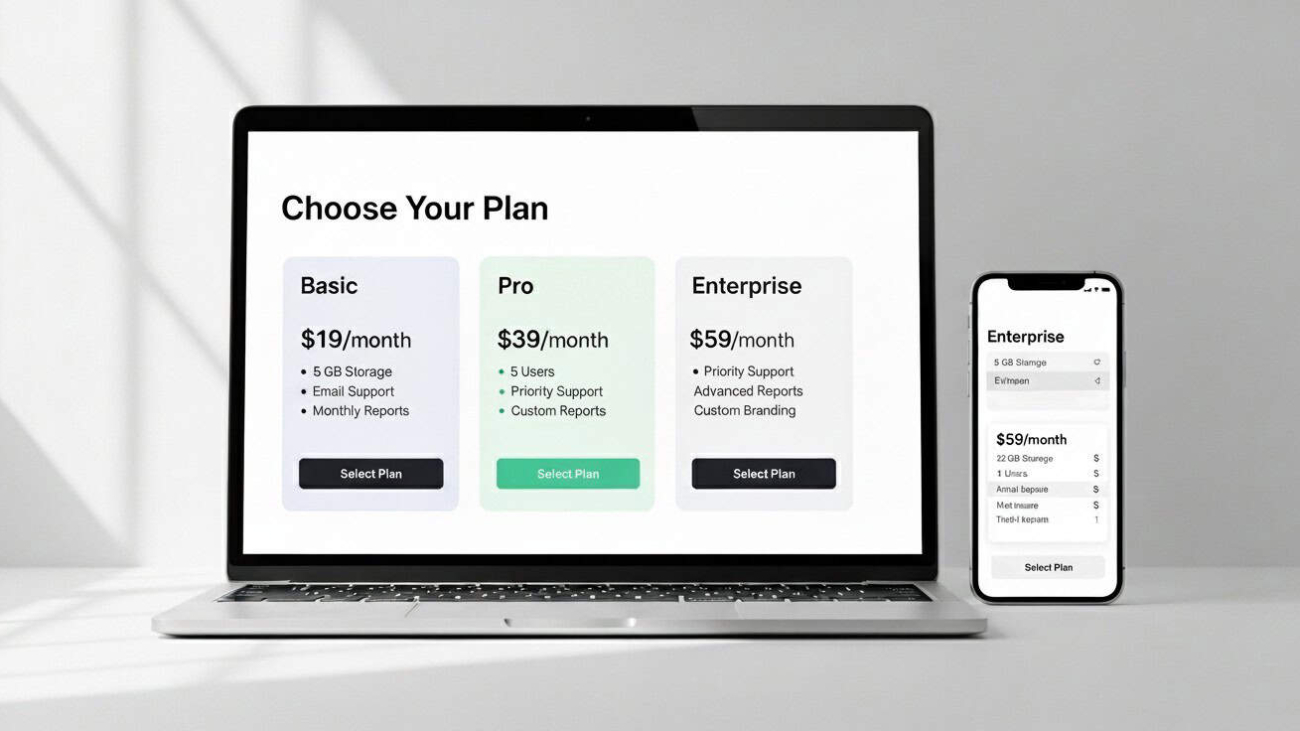
A laptop and a mobile phone showing different pricing plans

Service Pricing Pages That Convert In 2026

Service Pricing Pages That Convert In 2026

Why transparent pricing wins more work

Buyers want clarity before they talk to sales. A thoughtful pricing page reduces friction, filters out poor-fit enquiries and speeds up decisions. For Bradford and West Yorkshire service businesses, a clear pricing page can be the difference between casual interest and a booked call. It also performs well in search: pages that answer cost questions earn clicks for terms like website design pricing, SEO pricing UK or WordPress support costs, and they tend to attract links from roundups and forums because they are genuinely helpful.

What your pricing page needs above the fold

Start with a plain-English headline that states what you price and who it is for. Add a short subhead that frames the outcome rather than the inputs—faster site, more qualified enquiries, predictable support. Show one primary call to action and one secondary option. For example, Book a pricing call and Download a detailed scope template. This gives decisive and cautious buyers a next step without clutter.

Include a transparent “from” price or range for your core service. Ranges work well for bespoke work, provided you explain what changes the cost. If you truly cannot show figures, publish a calculator or three example packages that reflect reality, not a teaser you would never sell.

Packages that reflect how clients actually buy

Base packages on outcomes and must-have deliverables, not an arbitrary list of features. For a website design package, define the number of templates, CMS training, accessibility criteria, performance targets and launch support. For SEO, define the audit depth, technical fixes, content creation, digital PR focus and review cadence. Make inclusions and exclusions obvious so prospects do not need to ask basic questions.

Resist feature bloat. Three packages are usually enough: Essentials for start-ups, Growth for established SMEs and a Custom option for complex needs. Each should have a clear ideal buyer, typical timeline and expected results. Most importantly, price each package at a point your team can deliver profitably; a loss-leading entry package damages service quality and long-term trust.

Pricing package illustration showing three service tiers designed around how clients buy, with outcome-focused service packages, transparent pricing options, clear deliverables, business growth pathways and customer decision-making in a clean flat vector style.

Explain what drives price up or down

A short section titled What affects the price saves countless emails. Be specific:
• Scope: additional templates, multilingual content, e-commerce or integrations.
• Speed: shorter timelines increase cost because more resources are needed.
• Content: writing and photography add value but require budget.
• Compliance: accessibility standards, complex consent or security needs.
• Ongoing support: maintenance, hosting and retainers.
Tie each factor back to outcomes so it does not feel like nickel-and-diming.

Show Bradford proof without boasting

Local reassurance matters. Add one or two short mini case studies from Bradford or nearby towns that highlight the business context, the work delivered and the result. For example, “WordPress redesign for a Bradford manufacturer, LCP improved from 3.9s to 1.8s, enquiries up 46% in 90 days.” Keep it factual and link to the full story. This speaks to buyers who care about regional experience without turning your pricing page into a portfolio.

Handle objections before they become emails

A compact FAQ near the bottom clears doubts and keeps sales conversations focused:
• Do you work to fixed fees or day rates?
• What if we already have copy and images?
• Can you start with a smaller project first?
• How do payment schedules work?
• What happens after launch?
Answer in a friendly, pragmatic tone. If you are based near Leeds Bradford Airport and can meet in person, say so—face-to-face workshops can be a deciding factor for local firms.

Design choices that boost conversions

Keep the layout calm and scannable. Avoid comparison tables with twenty tick marks; most readers will skim past them. Use short paragraphs, clear subheadings and simple iconography only where it adds clarity. On mobile, ensure prices and key points appear without endless scrolling and keep CTAs persistent but unobtrusive.

Accessibility and performance are non-negotiable. Maintain strong colour contrast, large tap targets and visible focus states. Optimise images, preload key assets and avoid layout shifts so the page feels trustworthy and quick. These improvements help real users and support SEO via healthier engagement signals and stronger Core Web Vitals.

Website conversion optimisation illustration showing a clean, user-friendly service pricing page with clear visual hierarchy, mobile-responsive design, trust elements, strong call-to-action placement, accessible layout and streamlined customer journey in a modern flat vector style.

Pricing calculators that set expectations sensibly

A lightweight calculator can bridge the gap between fixed packages and bespoke proposals. Ask three to five high-impact questions—pages or templates, e-commerce yes/no, content support, timeline—and present an estimated range instantly with a clear caveat. Invite the user to email the estimate to themselves along with a scoping checklist. This approach captures warm leads while respecting the buyer’s need for ballpark figures before a call.

Talk about value without hiding the numbers

Explain where your price goes. Buyers are comfortable paying for planning, design, development, QA, accessibility and performance work when they understand the impact on speed, conversions and maintainability. Mention warranty windows, training and handover documentation. If you include post-launch support, outline what is covered. Transparency reduces haggling and aligns expectations before the first meeting.

SEO essentials for pricing pages

Pricing pages are natural link magnets when they are genuinely useful. Help searchers and search engines by covering the how much, what affects cost and what is included angles in one place. Use descriptive headings such as Website design pricing in Bradford or SEO pricing for UK SMEs where they read naturally. Add internal links from service pages and relevant blogs to your pricing page, and link back to those services so readers can dive deeper. Include Breadcrumbs for context and mark up the page with WebPage and FAQ schema if the Q&A is visible.

Ensure the page answers intent for both local and national searches. If you serve West Yorkshire primarily but can work UK-wide, say so. Keep meta tags honest—choose a title and description that match the content rather than chasing every keyword variation.

SEO pricing page illustration showing a search-optimised service pricing page with structured packages, internal linking, FAQ sections, local SEO elements, schema markup concepts, clear navigation and website performance indicators in a clean flat vector style.

How to increase lead quality with your pricing page

If you receive lots of tyre-kickers, add one or two gentle qualifiers to your enquiry form: budget range, approximate timeline or the primary outcome they want. Make these optional on the first step and required on the second step after engagement—most serious buyers will provide the detail. Follow up quickly with a helpful email that includes a scoping template and a link to a relevant case study. Leads feel supported, and your sales calls start at a higher level.

A 30-day plan to publish or improve your pricing page

Week 1: Gather inputs. Interview sales and delivery teams, shortlist three real packages and list common price drivers.
Week 2: Draft the page. Write clear package summaries, add Bradford mini case studies and a short FAQ.
Week 3: Build and optimise. Create a lean template in WordPress, compress images, test Core Web Vitals and implement FAQ schema if used.
Week 4: Launch and measure. Link from service pages, post an update on Google Business Profile, and track conversions and assisted conversions in GA4. Refine the intro and CTAs based on early behaviour.

Why work with a Bradford-based team

Pricing pages work best when they reflect local buyer expectations and the realities of delivery. Because we are based in Bradford, we can meet quickly, align on scope, and create a page that’s honest, fast and persuasive. We combine conversion copy, technical SEO and WordPress performance so your pricing page ranks for cost queries and converts the right clients—without gimmicks.

A man pointing at a screen showing analytics

Case Studies That Rank And Sell: A Bradford Guide For Service Brands

Case Studies That Rank And Sell: A Bradford Guide For Service Brands

Why case studies outperform generic sales pages

When prospective clients land on your website, they are looking for proof. Case studies provide it in a human way: real problems, clear actions, measurable results. Done well, they improve SEO, build trust and lift conversion rates across your site. For Bradford and West Yorkshire businesses, local case studies also add regional credibility that generic portfolios cannot match. This guide explains how to plan, write and optimise case studies that rank for meaningful searches and turn readers into enquiries.

Choose projects that mirror the work you want more of

Start by shortlisting projects that represent your ideal future pipeline. Aim for variety across sectors you serve in Bradford, Leeds and wider Yorkshire, but be selective. The perfect candidate meets three criteria: the client’s problem is common in your market, your solution is repeatable for others, and the outcome is measurable. If confidentiality prevents naming the client, you can anonymise responsibly by sharing sector, company size and challenge while removing identifiable details. The goal is to show believable transformation without breaching trust.

Gather evidence before you write a word

Great case studies are built on specifics. Capture quantitative metrics such as page speed improvements, conversion lift, cost per lead reductions or revenue growth. Pair them with qualitative insights: quotes from the client, pain points before the project, and what changed in day-to-day operations. Screenshots from GA4, Search Console and PageSpeed Insights (with sensitive data redacted) make the narrative concrete. If results developed over time, show milestones at 30, 60 and 90 days to set realistic expectations.

Case study research illustration showing a business professional gathering client data, performance metrics, notes, reports and supporting evidence before writing a case study, with organised documentation, analytics insights and project planning elements in a clean flat vector style.

Structure that helps humans and search engines

Use a simple, repeatable format so readers know what to expect and search engines can parse context reliably.

Project snapshot
Open with a two or three sentence summary covering the client type, the main challenge and one headline result. Include location if relevant to local SEO, for example “Bradford-based manufacturer” or “Leeds professional services firm”.

The challenge
Explain the real-world problem in plain English: slow mobile site, low enquiry quality, weak local visibility, or poor conversion from paid traffic. Keep jargon out and mirror the language clients use on calls.

What we did
Break actions into clear steps. For a website redesign, this could include discovery, information architecture, WordPress build, Core Web Vitals improvements, content refresh and launch support. For SEO, outline technical fixes, content strategy, internal linking and Google Business Profile work. Be specific about tools and decision-making so your expertise is visible.

Results that matter
Lead with two or three metrics tied to the original goal. For example, “Largest Contentful Paint improved from 4.2s to 1.9s on mobile, enquiries up 58%, cost per lead down 32%.” Avoid vanity stats and explain what the numbers mean for the client’s bottom line.

Client perspective
Add a short quote in the client’s voice. If you cannot name them, attribute by role and sector, such as “Marketing Manager, Yorkshire B2B services”.

Next steps and longevity
Close with what happened after launch: ongoing maintenance, content optimisation, or new features delivered. This shows you do not disappear once the invoice is paid and reinforces lifetime value.

Write like a person from Bradford would speak

Keep sentences short, verbs active and promises grounded. Replace generic claims with concrete actions: “We consolidated 12 thin pages into a single, well-structured guide and added an enquiry form above the fold” is more powerful than “We improved content quality.” Where appropriate, weave in local details briefly—meeting near Leeds Bradford Airport for kick-off sessions, or collaborating with a supplier in Little Germany—only when it adds credibility rather than padding the word count.

SEO for case studies without turning them into keyword soup

Target one primary intent per case study and reflect it in the title, H1 and meta tags. Mix broad and local angles where natural, for example “WordPress redesign and Core Web Vitals improvement for a Bradford manufacturer.” Use descriptive internal links from related service pages and blogs to each case study, and link back from the case study to the most relevant service. Add Breadcrumbs so the case study sits logically within your site structure. Optimise images with descriptive filenames and alt text that describe the purpose of the image rather than stuffing keywords.

SEO case study illustration showing a search-optimised business case study with performance results, local SEO relevance, structured content sections, internal linking, metadata optimisation and organic growth indicators, presented in a clean flat vector style.

Schema and on-page enhancements that earn richer results

Add Article or BlogPosting schema for the case study, plus BreadcrumbList site-wide. If you include ratings or testimonials on the page, follow platform rules and mark them up responsibly to avoid spam signals. Include datePublished and dateModified so freshness is clear. A compact FAQ at the end can answer common questions about timelines, budgets and team roles; mark it up only if the Q&A is visible on the page.

Core Web Vitals still decide whether people read to the end

A brilliant story will not land if the page is slow or jumpy. Preload the hero image, serve images in WebP, reserve space for media to prevent layout shift and defer non-essential scripts. Keep design clean: a single column for copy with subtle pull-quotes and short data callouts is easier to read than busy grids. Fast, stable case study pages encourage deeper sessions and more enquiries—human benefits that also support SEO.

Turn a single case study into a small content engine

One strong case study can fuel multiple assets. Publish a 200–300 word summary on Google Business Profile with a link back to the full page, create a short LinkedIn carousel showing the problem, actions and results, and record a two-minute video walkthrough for your blog. Link these back to the main case study so it becomes the canonical source. Over time, build a sector filter on your case studies hub so prospects can find relevant stories quickly.

Case study content repurposing illustration showing a single business case study being transformed into multiple marketing assets including blog posts, social media content, email campaigns, landing pages, testimonials and SEO resources, connected through a central content strategy in a clean flat vector style.

Measurement that focuses on pipeline, not vanity metrics

In GA4, track scroll depth, outbound clicks to supporting assets and enquiry events on or after viewing a case study. Use assisted conversions to credit case studies that play a role earlier in the journey. In Search Console, group case study URLs to monitor impressions and clicks collectively and by sector. If a case study earns traffic but few enquiries, move proof points higher, tighten the intro and add a clearer next step.

A 30-day plan to publish your best case study yet

Week 1: Pick a project with measurable outcomes, gather data and interviews, and secure client approval for the story and quotes.
Week 2: Write the case study using the snapshot–challenge–actions–results structure. Add screenshots, before/after metrics and a short FAQ.
Week 3: Build the page in WordPress, optimise images, implement schema and connect internal links from relevant service pages and blogs.
Week 4: Publish, create a Google Business Profile update, share a LinkedIn summary, and review GA4 and Search Console after two weeks to refine the opening and calls to action.

Why a Bradford-based partner makes this easier

Local understanding speeds up everything from interviews to approvals. Because we are based in Bradford, we can meet quickly, collect the right data, and write in a voice your clients recognise. We bring together content strategy, technical SEO and clean WordPress builds so your case studies load fast, read well and contribute directly to pipeline. If you want stories that win trust and rankings, we can help you produce them predictably.